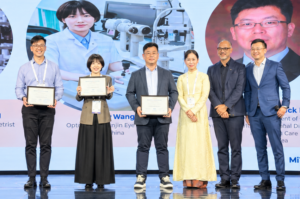
HOYA Vision Care announced Na Wang of Tianjin Eye Hospital Optometric Center as the Asia-Pacific winner of its second MiYOSMART Case Study Contest at the 5th Asia Optometric Congress (AOC), held 19–20 September 2026 in Da Nang, Vietnam. Na Wang presented a case on combining MiYOSMART iQ spectacle lenses with a structured vision therapy program to treat myopia and binocular vision dysfunction, demonstrating clinical excellence in myopia management and reflecting the contest’s aim of recognizing and sharing best practices that help improve outcomes for children.
Now in its second edition, the MiYOSMART Case Study Contest gives Eye Care Professionals (ECPs) a platform to put real patient outcomes at the center of the conversation. The 2026 Asia-Pacific finalists’ cases spanned an unexpected binocular vision complication, a multi-year comparative management record, and a transparent view of the insights and limitations of real-world myopia progression and axial length monitoring.
“The MiYOSMART Case Study Contest supports peer-to-peer learning by transforming real patient cases into practical insights for the wider optometric community. The Asia-Pacific region faces one of the world’s most significant and rapidly growing myopia challenges, thus making this platform especially important,” said Serge Zins, Vice President Asia Pacific, HOYA Vision Care. “Each finalist has demonstrated dedicated care and thoughtful innovation in their clinical approach – values that Eye Care Professionals across the region bring to their work every day, and that are core to HOYA Vision Care’s purpose of improving life through vision.”
Three finalists, representing China, South Korea, and Singapore, were shortlisted from entries across the Asia-Pacific region and presented their cases to a panel including Dr. John Nakpil, Director and Optometrist at Nakpil Eye Clinic, Philippines, and Dr. Tang Yan, Deputy Chief Physician at Beijing Aier Intech Eye Hospital, China, who was also the winner of the first edition of the MiYOSMART Case Study Contest back in 2024. The audience then voted for the case presentation they felt best demonstrated clinical excellence in myopia management.
| Country | ECP & practice | Case study focus |
| China | Na Wang, MSc, Optometrist, Tianjin Eye Hospital Optometric Center | Addressed an underlying binocular vision dysfunction in a 12-year-old girl through vision therapy alongside transition to MiYOSMART iQ spectacle lenses. |
| South Korea | Prof. Seong-Wok Lee, Oh My Glasses Vision Care | A four-year comparison of two young myopic children, one of whom moved from single vision correction to MiYOSMART iQ, illustrated how consistent myopia management paired with parent education supported more stable outcomes over time. |
| Singapore | Douglas Wong, United Optometrist | A three-year clinical record, including a period outside the practice’s care, provided a transparent view of the insights and limitations of real-world myopia progression and axial length monitoring. |

This year’s winner, Na Wang of Tianjin Eye Hospital Optometric Center, was recognized by both the panel and audience for a case focused on treating myopia and a previously undetected binocular vision dysfunction in a 12-year-old female patient with a combined approach of MiYOSMART iQ spectacle lenses and a structured vision therapy program. Na Wang’s treatment paradigm resolved the patient’s symptoms within four months.
Na Wang stated: “It’s a privilege to be recognized among such strong finalists from across the region. This case reflects what consistent, evidence-based myopia management can mean for a child in daily life, and I hope sharing it is useful to other Eye Care Professionals managing similar cases.”
“Myopia affects one in three children and teenagers worldwide,3 and the urgency of early intervention has never been greater,” said Jerome Lee, Global Professional Affairs Manager at HOYA Vision Care. “The MiYOSMART Case Study Contest exists to celebrate the ECPs rising to that challenge, and to give them a platform to exchange expertise and improve outcomes for the children who need it most.”
For more information about the MiYOSMART Case Study Contest, please visit: https://www.hoyavision.com/vision-products/miyosmartVr25/miyosmart-contest/
###
How do MiYOSMART and MiYOSMART iQ spectacle lenses work to manage myopia progression?
In myopic eyes, light focuses in front of the retina so distant objects appear blurred. This is often caused by axial elongation – abnormal elongation of the eye.4 Using Defocus Incorporated Multiple Segments (D.I.M.S.) Technology, MiYOSMART and MiYOSMART iQ contain tiny defocus segments arranged in a honeycomb structure inside the larger spectacle lens. The segments create simultaneous defocus intended to continuously activate the near-peripheral retina. There are no segments in the clear central zone, so the child can see clearly.
How is MiYOSMART iQ different from MiYOSMART?
Building on the proven foundation of D.I.M.S. Technology, MiYOSMART iQ introduces a more advanced approach to myopia control. MiYOSMART iQ elevates the D.I.M.S. Technology of MiYOSMART with Triple Enhanced Design features:
- Defocus segments positioned closer to the geometric center of the spectacle lens, intended to continuously activate the near-peripheral retina identified as the region most responsive to myopic defocus.5-7
- Higher defocus power, enabling a stronger myopic defocus signal to the near-peripheral retina.
- Extended treatment zone with more defocus segments, expanding the coverage of the child’s peripheral visual field with myopic defocus signal, even for larger frames.
What clinical evidence supports MiYOSMART iQ spectacle lens performance?
12-month randomized controlled clinical trial findings for MiYOSMART iQ spectacle lenses were presented at the Association for Research in Vision and Ophthalmology (ARVO) Conference 2026.2 The data showed:
- No clinically relevant myopia progression* in the first year of wear in 9 of 10 children aged 4–12 years wearing MiYOSMART iQ.1
- Minimal eye growth on average in the first 12 months of wear*1,2,8
- MiYOSMART iQ is HOYA’s first spectacle lens with reported clinical evidence for effective control of myopia progression from the age of 4 years, as a monotherapy*1,2,8,10
- Myopic children as young as 4 and up to 12 years of age adhered well to wearing MiYOSMART iQ spectacle lenses every day and all day long in the study.1,2,10
Disclaimer: This material is intended for informational purposes for professional audiences and reflects scientific findings presented at a professional conference. It is not intended as a promotion or solicitation for any product in jurisdictions where such product is not approved, including the United States. Product availability and approvals vary by country.
###
Footnotes
*Clinically relevant myopia progression is a change in cycloplegic spherical equivalent of -0.50D or worse.
Outcomes for myopic children aged 4 to 12 years and may vary per age group and other parameters at the start of MiYOSMART iQ treatment.
References
- HOYA data on file. HOYA MiYOSMART iQ spectacle lens clinical outcomes. 04/2026
- Tse DYY, Hon Y, Chun RKM, et al. Myopia Control Efficacy of Defocus Incorporated Multiple Segments Spectacle Lens with Triple Enhanced Design: a 12-month randomized controlled trial. Ophthalmol. Vis. Sci. 2026;67(7):2523. https://iovs.arvojournals.org/article.aspx?articleid=2815754(accessed date 24.09.26)
- Liang J, et al. Global prevalence, trend and projection of myopia in children and adolescents from 1990 to 2050: a comprehensive systematic review and meta-analysis. Br. J. Ophthalmol. 2025;109(3):362–71.
- Carr BJ, et al. The Science Behind Myopia. 2017. In: Webvision: The Organization of the Retina and Visual System [Internet]. Salt Lake City (UT). University of Utah Health Sciences Center. https://www.ncbi.nlm.nih.gov/books/NBK470669/(accessed date: 24.09.2026).
- Smith III EL, Arumugam B, Hung LF, et al. Eccentricity-dependent effects of simultaneous competing defocus on emmetropizationin infant rhesus monkeys. Vision. Res. 2020 Dec;177:32-40. doi: 10.1016/j.visres.2020.08.003
- Panorgias A, Aigbe S, Jeong E, et al. Retinal responses to simulated optical blur using a novel dead leaves ERG stimulus. Invest. Ophthalmol. Vis. Sci.2021;62(10):1. https://doi.org/10.1167/iovs.62.10.1(accessed date 24.09.26)
- Swiatczak B, Scholl HPN & Schaeffel F. Retinal “sweet spot” for myopia treatment. Sci Rep14, 26773 (2024). https://doi.org/10.1038/s41598-024-78300-x(accessed date 24.09.26)
- Kaymak H, Devenijn M, Tse DYY, et al. Defocus Incorporated Multiple Segments Spectacle Lenses with Triple Enhanced Design Normalize and Neutralize Axial Elongation in Myopic Children: A Randomized Three-Arm Trial Using AMMC Physiological Growth Criteria. Invest. Ophthalmol. Vis. Sci. 2026;67(7):OD72. https://iovs.arvojournals.org/article.aspx?articleid=2817675(accessed date 24.09.26)
- Tse DYY, Chun RKM, Hon Y, et. al. Myopia Control Efficacy of Defocus Incorporated Multiple Segments Triple Enhanced Design Spectacle Lenses. The 41st Asia-Pacific Academy of Ophthalmology (APAO) Congress, 2026, https://2026.apaophth.org/abstract/?code=205567(accessed date 24.09.2026).
- Sankaridurg P, Berntsen DA, Bullimore MA, et al. IMI 2023 digest. Invest. Ophthalmol. Vis. Sci.2023;64(6):7. https://doi.org/10.1167/iovs.64.6.7(accessed date 24.09.2026).
- HOYA data on file. MiYOSMART spectacle lens commercial data. 04/2026.