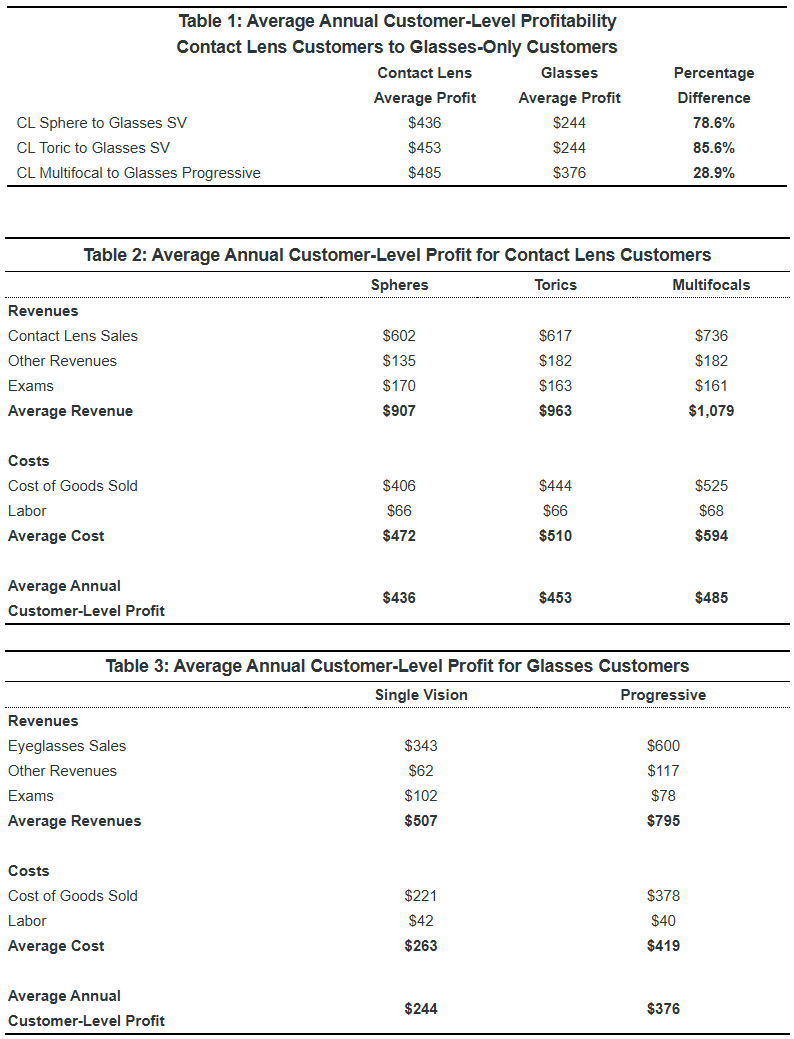
A new study from a team of ophthalmic and economics researchers has shown that soft contact lens patients create a sizable practice profitability advantage compared to equivalent glasses-only patients. The upside ranges from 29% to 86% annually (Table 1), with substantial potential gains over a lifetime of wear.
To calculate the differences, 20 United States-based eye care practices each submitted four years of anonymized data for 30 patients, as well as detailed operations data such as professional fees, chair time, staff compensation, and secondary revenue streams. The resulting average annual customer-level profits across contact lens types are $436 for spheres, $453 for torics, and $485 for multifocals (Table 2), compared to $244 for single vision and $376 for progressive glasses patients (Table 3).
Analysis was conducted by Professor Philip Morgan (University of Manchester), Professor Lyndon Jones (CORE / University of Waterloo), and Professors Ash Morgan and John Whitehead (Department of Economics, Appalachian State University). Contact Lens Institute (CLI) commissioned the study as part of its multi-year See Tomorrow initiative.
Rethinking Practice Economics and Lifetime Value
“It’s clear that contact lens customers can generate greater average annual profit, even with higher service and product costs. Our findings suggest that recurring purchases, greater examination frequency, and opportunities for ancillary spending may make contact lens wearers particularly attractive from a customer lifetime value perspective,” said Professor Philip Morgan.
The work is the first-ever analysis of contact lens profitability in the U.S. It comes 25 years after publication of the widely cited London Business School “Seeing Things Clearly” study, which looked at the topic in five European markets.
“The new data squarely challenges profitability myths that can creep into conversation despite a lack of evidence. For instance, prior CLI See Tomorrow work showed that more than half of eye care practices don’t even attempt to quantify the business impact of their contact lens patients. Among those who do, they significantly underestimate the relative profitability compared to glasses-only patients,” said Stan Rogaski, CLI’s executive director.
“We know that wearers deeply value their contact lenses for vision, convenience, and lifestyle, and are willing to pay for those benefits. Our hope is that these findings spur practices to reconsider their approaches to providing the best possible care, including prescribing both contact lenses and glasses for patient and practice gain alike.”
The complete findings will be published later this year as part of a comprehensive CLI See Tomorrow report.
Contact Lens Institute advances the latest innovations in safe and effective contact lens and lens care products and services that provide unique benefits to patients while satisfying the evolving needs of eye care professionals. CLI undertakes activities that properly assess, enhance, promote and balance contact lens and lens care industry welfare and growth, including the safe use of products in the marketplace. Its members include Alcon, Bausch + Lomb, CooperVision, and Johnson & Johnson Vision. For more information, visit contactlensinstitute.org.
# # #