

In a city defined by movement, Ray-Ban introduces a space that slows things down just enough to feel something.
Ray-Ban House opens in Soho not as a store, but as a shift in perspective. A place where retail dissolves into culture, and where the boundaries between seeing, wearing, listening and gathering begin to blur.
Conceived by the brand’s internal creative team, the project takes shape as an urban interior, part home, part stage, part living archive of objects and ideas. It is rooted in New York, but resists definition. A space that belongs as much to the street outside as it does to the people moving through it.
On the corner of Prince and Lafayette, a two story townhouse becomes something fluid. By day, the architecture reflects the city in soft distortions, curved metal surfaces catching fragments of passing light. By night, it turns inward and glows outward, a quiet signal, a kind of beacon.
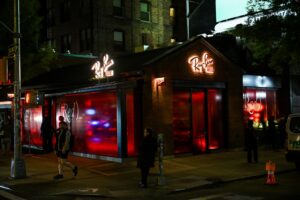
Ray-Ban House Soho: An Intersection of Design and Gastronomy
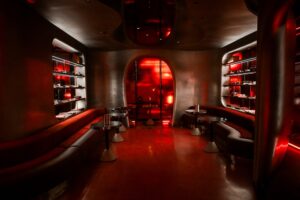
Inside, the environment unfolds without hierarchy. Satin metal curves, mirrored ceilings, deep red floors. Everything feels continuous, almost cinematic. Eyewear sits alongside vinyl, books, found objects. Not displayed, but placed. Not sold, but contextualized.
The space moves like New York does. Open, layered, slightly unpredictable. At its center, the kitchen becomes part of the same narrative. Led by Pasquale Cozzolino, the food offering mirrors the cultural layering of the space itself. It is not defined by a single cuisine, but by movement between them. Japanese milk bread sandos are reinterpreted through an American sensibility, sitting alongside raw preparations, carpaccios and small plates designed to be shared.
The rhythm follows the city. Lighter, more precise moments during the day, matcha, cold pressed juices, a sense of pause. Then a gradual shift into something more layered and social as the day unfolds. The experience is continuous, evolving rather than segmented. Nothing feels fixed. Everything overlaps.
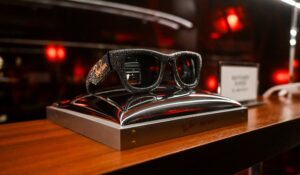
Ray-Ban’s world is present, but never imposed. Core icons sit alongside experimental forms from Ray-Ban Studios, silhouettes that stretch the brand’s language into something sharper, more instinctive. Objects that feel less like products and more like propositions. Upstairs, behind a concealed entrance, the space contracts. The VIP Room offers a different tempo, quieter, more precise. Here, the Wayfarer Puffer Diamond becomes something personal. Materials, stones, colour assembled into singular pieces that move closer to jewelry than eyewear.
Ray-Ban House does not ask to be understood all at once. It builds through presence, through repetition, through return.
On May 4th, the space opened with a moment that reflected its intent. Oscar and the Wolf performed to a room that blurred audience and atmosphere, followed by Daniela Lalita. Jennie Kim, global ambassador, moved through the night alongside a cross section of the city, familiar faces, new energies, no clear boundary between them.
This is not a flagship. Not a concept store. Not quite a venue.
It is a place to return to. This must be the place.
ADDRESS:
62 Prince Street
New York, NY 10012
HOURS:
Monday – Sunday
10AM – 8PM
Ray-Ban is distributed in Canada by EssilorLuxottica.