
Researchers at the University of Waterloo have developed a new approach to manufacturing contact lenses that could make fully customized vision correction available in a single optometrist visit.
By combining a specially engineered silicone material with advanced 3D printing and digital design software, the team can produce patient-specific contact lenses in about 20 minutes. The technology is designed to replace the lengthy fitting process often required for people who need specialty lenses.
“We are very excited about this work because it brings us closer to contact lenses that are truly personalized,” said Dr. Shirley Tang, professor in Waterloo’s Department of Chemistry. “Our technology produces lenses with patient-specific surfaces for a precise fit while delivering the optical clarity and mechanical performance expected of commercial contact lenses.”
Bringing Customized Contact Lenses Closer to the Clinic
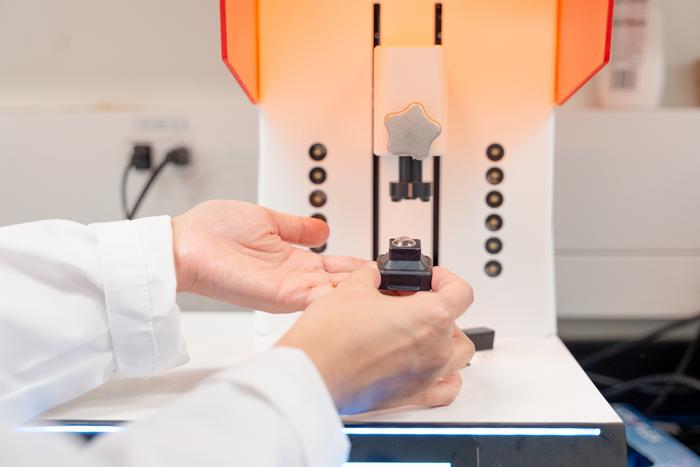
Unlike conventional contact lenses, which are manufactured in a limited range of standard sizes, the new system creates lenses based on the unique shape of each patient’s eye. This could be especially beneficial for people with irregular corneas, who often rely on rigid lenses and may need multiple appointments before finding a comfortable fit.
A major hurdle was adapting silicone—the preferred material for contact lenses because of its safety, comfort and oxygen permeability—for 3D printing. The Waterloo researchers addressed this by developing a new hydrophilic silicone formulation that is compatible with additive manufacturing without sacrificing the qualities required for everyday wear.
“Our software designs a lens with an inner surface that precisely matches the patient’s cornea and an outer surface that provides the required vision correction,” said Dr. Sayan Ganguly, Chemistry research associate at Waterloo. “The novel hydrophilic silicone material we created, combined with our manufacturing process, produces smooth, transparent lenses that are comfortable to wear.”
The team also introduced a non-contact surface finishing process that removes the microscopic ridges typically left by layer-by-layer 3D printing, improving both optical clarity and wearer comfort while preserving the lens’s customized geometry.
After successful laboratory tests confirming the material’s biocompatibility, the researchers are preparing for in vivo studies. They have filed a provisional patent for the new silicone material and are working toward commercialization through the Centre for Vision and Eye Research (CEVR), a joint institute of the University of Waterloo and the Hong Kong Polytechnic University.
The project recently earned a Gold Medal at the Shanghai International Exhibition of Inventions in June 2026.